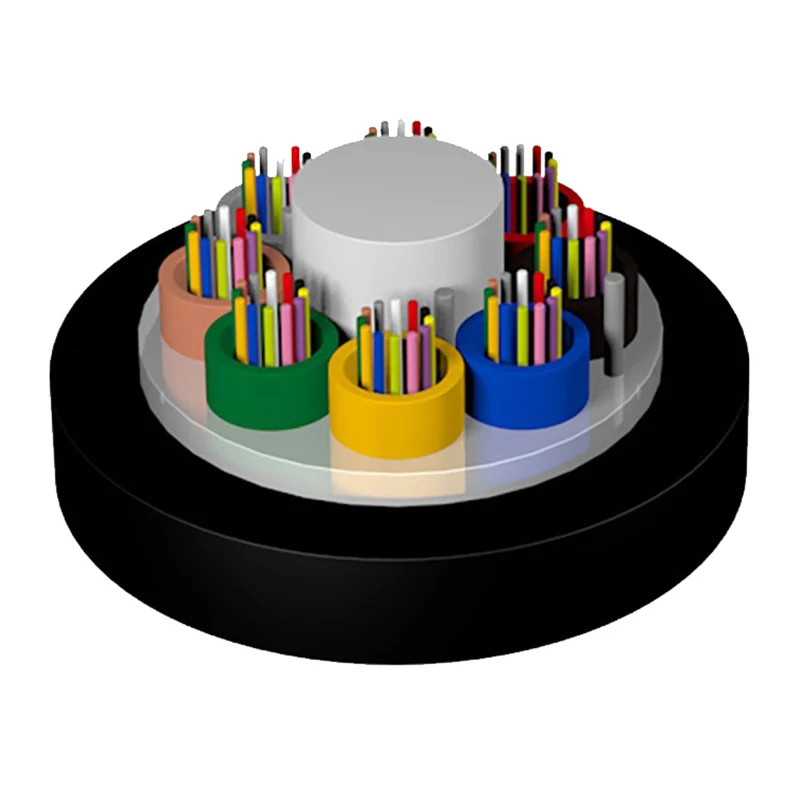
Air-blowing micro cable, also known as micro-cable using air blasting, is a cable installation technique that uses compressed air to blow small cable materials into and secure them at the desired location. This technology is primarily used in scenarios with limited space or strict construction requirements. The outer diameter of air-blowing micro cables is typically much smaller than that of traditional conduit cables, allowing more fiber optic cables to be installed in the same conduit space, thus improving the utilization rate of the conduit. The installation process for air-blowing micro cables is relatively simple; a blower machine can quickly blow the micro cable into pre-installed micro tubes without the need for complex pulling or laying operations, reducing construction difficulty and enhancing efficiency. Once inside the micro tubes, the micro cables are well protected from external environmental damage, extending their lifespan. Air-blowing micro cables are highly flexible and durable, making them suitable for various environmental conditions and construction needs, particularly in space-constrained scenarios. Replacing air-blowing micro cables does not damage the existing micro tubes, and the replaced cables can be reused, saving costs. These cables blend seamlessly with their surroundings, minimizing their impact on nearby facilities and enhancing their concealment.
In data centers, air-blowing micro cables can be used to connect servers, storage devices, and other equipment, providing high-speed, stable data transmission channels. With the rapid development of 5G networks, air-blowing micro cables play a crucial role in the construction and interconnection of 5G base stations, offering high-speed, low-latency communication support. They are suitable for cable installation in metropolitan area networks (MANs) and access networks, especially when network expansion or upgrades are needed. Air-blowing micro cables can quickly and efficiently complete cable installation tasks. In long-distance communication lines, they can supplement or replace traditional cables, increasing the capacity and stability of communication lines. Additionally, air-blowing micro cables are ideal for special environments where direct cable installation is challenging, such as bridges, tunnels, and mountainous areas.