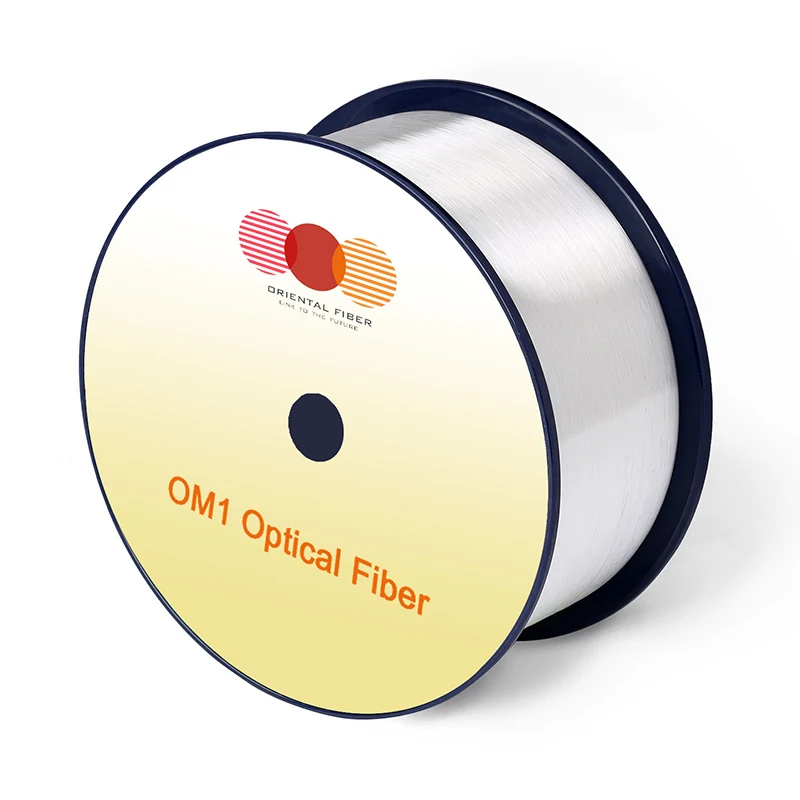
The digital backbone of many established enterprise and industrial networks continues to rely on the proven stability of 62.5/125μm technology. Orientalfiber provides a premium Multi-mode Optical Fiber OM1 solution that prioritizes physical durability and optical consistency for short-to-medium reach applications. Produced under the rigorous quality standards of Jiangsu Xuben Photoelectric Technology Co., Ltd, this fiber ensures that your current hardware investment continues to deliver reliable voice, video, and data services without necessitating a premature and costly system-wide overhaul.
PCVD Manufacturing: Achieving Precision at the Molecular Level
Unlike standard manufacturing methods that can lead to inconsistencies in the core, the Multi-mode Optical Fiber OM1 produced by Orientalfiber utilizes the Plasma Chemical Vapor Deposition (PCVD) process. This sophisticated approach provides several critical advantages:
Refined Refractive Index Grading: By depositing ultra-thin layers of silica, we achieve an extremely fine graded-index profile. This minimizes modal dispersion, allowing for higher bandwidth at both 850nm and 1300nm.
Superior Geometry Control: Precise core-to-cladding concentricity reduces splice loss, a vital factor for technicians performing field terminations in high-density patch panels.
Enhanced Surface Integrity: The fiber is protected by a specialized double layer of UV-curing acrylate, offering the mechanical toughness required for processing into tight-buffered cables.
Purchasing decisions for infrastructure projects often hinge on the balance between cost-efficiency and long-term hardware compatibility. Our Multi-mode Optical Fiber OM1 addresses these specific operational pain points:
Seamless Integration with Existing 62.5μm Architectures
Many campus and industrial networks were built on the 62.5/125μm standard. Our Multi-mode Optical Fiber OM1 matches these legacy Mode Field Diameters (MFD) perfectly. This prevents the high attenuation levels typically encountered when attempting to patch mismatched 50μm and 62.5μm fiber types.
Resilience in Rigorous Industrial Environments
Whether deployed in electrical power grids, rail transit systems, or highway monitoring, the physical environment is often unforgiving. Our fiber is tested for high bending performance, ensuring it remains stable in the compact enclosures and high-vibration areas common in industrial front-end connections.
Verified Compliance via Jiangsu Xuben Photoelectric Technology Co., Ltd
As a key brand within a group company operating four dedicated factories across 15,000 square meters, Orientalfiber ensures your supply chain is backed by a manufacturer with an annual output of 20 million US dollars and ISO9001/ISO45001 certifications.
Critical Performance Benchmarks
Low Signal Attenuation: Optimized for short-reach backbone and horizontal cabling, reducing the need for active signal regeneration
Broad Light Source Support: Engineered to perform reliably with both cost-effective LED sources and modern VCSEL laser light sources.
Environmental Adaptability: Designed to maintain optical integrity across a wide range of temperatures, making it suitable for outdoor cable integration.
Standard Compliance: Fully adheres to ISO/IEC 11801-1 OM1 and TIA-492AAAF A1-OM1 international specifications.
Deployment Scenarios for Modern Network Operators
The versatility of Multi-mode Optical Fiber OM1 makes it a staple for diverse sectors:
Corporate LAN Infrastructure: Linking localized switches and server rooms for steady 100/1000 Mbps throughput.
Public Broadcasting: Supporting the high-reliability data transmission needs of radio and television communication systems.
Industrial Automation: Serving as the primary link for sensors and actuators in power plants where electromagnetic interference (EMI) is a concern.
Industry Insight & FAQ
How does Orientalfiber guarantee the longevity of OM1 fiber?
By applying a dual-layer UV-cured acrylate coating, we safeguard the Multi-mode Optical Fiber OM1 against micro-cracks and moisture ingress. This ensures a service life that matches the 20+ year requirements of major infrastructure projects.
Is OM1 still the right choice for new industrial expansions?
If your existing network equipment—such as transceivers and media converters—is configured for 62.5μm, staying with Multi-mode Optical Fiber OM1 is the most cost-efficient path. It allows for expansion without the massive capital expenditure of replacing all active electronics to support 50μm standards.
What total solutions does Jiangsu Xuben Photoelectric Technology Co., Ltd offer?
Beyond raw fiber, our group provides indoor and outdoor optical cables, ODN components, and network equipment. This holistic approach ensures that the Multi-mode Optical Fiber OM1 you purchase is fully optimized for the components it will be paired with.
Specifications
Characteristics
Conditions
Specified values
Units
Geometry Characteristics
Core Diameter
--
62.5±2.5
[μm]
Core Non-Circularity
--
≤5.0
[%]
Cladding Diameter
--
125.0±1.0
[μm]
Cladding Non-Circularity
--
≤1.0
[%]
Coating Diameter
--
245±7
[μm]
Coating/Cladding Concentricity Error
--
≤10.0
[μm]
Coating Non-Circularity
--
≤6.0
[%]
Core/Cladding Concentricity Error
--
≤1.5
[μm]
Delivery Length
--
up to 17.6
[km/reel]
Optical Characteristics
Attenuation
850nm
≤2.7
[dB/km]
1300nm
≤0.6
[dB/km]
Overfilled Modal Bandwidth
850nm
≥200
[MHz·km]
1300nm
≥500
[MHz·km]
Numerical Aperture
--
0.275±0.015
--
Group Refractive Index
850nm
1.496
--
1300nm
1.491
--
Zero Dispersion Wavelength,λ0
--
1320~1365
[nm]
Zero Dispersion Slope,S0
1320nm≤ λ0 ≤1348nm
≤0.11
[ps/(nm2·km)]
1348nm≤ λ0 ≤1365nm
≤0.001(1458-λ0 )
[ps/(nm2·km)]
Macrobending Loss
--
--
--
100 Turns @ 37.5 mm Radius
850nm
≤0.50
[dB]
1300nm
≤0.50
[dB]
Backscatter Characteristics
1300nm
Step(Mean of Bidirectional Measurement)
--
≤0.10
[dB]
Irregularities Over Fibre Length and Point Discontinuity
We use cookies to offer you a better browsing experience, analyze site traffic and personalize content. By using this site, you agree to our use of cookies.
Privacy Policy